Beyond Good Enough: Two Aurubis Finland Employees Learn the Language of the Job
Swedes speak excellent English. Henna Rantala learned Swedish anyway to communicate with her Swedish customers. Her colleague Kaisa Kekki’s English was fine, but it lacked the words of her own profession. Two employees at Aurubis Finland on what the right language changed in their work.
About nine-tenths of what Aurubis Finland produces in Pori is exported, so much of its work happens in emails, phone calls and meetings, often in a language that is not the speaker’s own. The company, part of Aurubis AG since 2011, employs more than 300 people and runs the Nordic region’s only copper rolling mill with an integrated foundry. Two of its employees have studied with IWG Institute: Henna Rantala, who speaks Swedish with customers, and Kaisa Kekki, who uses English in HR as international cooperation has grown.
Speaking the customer’s language
Henna is Customer Service Team Leader at Aurubis, responsible for customer service for Nordic customers, order processing and shipments. She speaks Swedish with customers every day.
When she took responsibility for the company’s Swedish customers, her Swedish was where the Swedish of many Finns is after school: the foundation was there, but not enough to serve customers as well as she wanted. About five years ago she decided to study it properly.
One phone call from those years stands out. It was her first call with a particular customer, who was delighted that the call could be in Swedish. It was also the first time, Henna says, that she felt on the phone that her Swedish really worked, and she easily understood what the customer was saying.
English would have been enough, as Swedes generally speak very good English. Even so, Henna has found that Swedish is appreciated, most of all when she is the only Finnish speaker among Swedes. Customer relationships have deepened, she says, especially after face-to-face meetings where she could chat in Swedish. “I hope customers are also left with a positive impression of Aurubis, that we are able to serve them in their own language.”
The IWG courses gave her courage – a lot of courage – to use Swedish even when it is not always perfect. The teachers were encouraging and supportive, and seeing her skills develop kept her motivated, even after a break in her studies.
Henna is now gradually moving from Customer Service Team Leader to Junior Sales Manager, still working with the Swedish customers, now from a sales perspective. “Certainly one factor in my being chosen for the new role was that I speak my customers’ language,” she says.
Learning the language of your own job
Kaisa Kekki is HR Partner at Aurubis, responsible for the whole employment lifecycle of salaried employees, from recruitment to the end of employment. Her career has grown from HR Trainee to her current role.
English itself was not the problem for Kaisa. Before the courses, her English was good for travelling and everyday situations. “The HR vocabulary needed at work was quite limited,” she says. As international cooperation increased, Kaisa wanted a broader professional vocabulary and more confidence in discussions, meetings and written communication. In 2022, as an HR Specialist, she started English courses with IWG, followed by a second course in 2023.
What worked, she says, was that the teaching was built on real working-life situations: “We practised practical conversations and vocabulary that I could use straight away in my own work.” A great teacher, an encouraging atmosphere and the chance to practise speaking in a safe environment built her confidence, and seeing her own progress motivated her to continue.
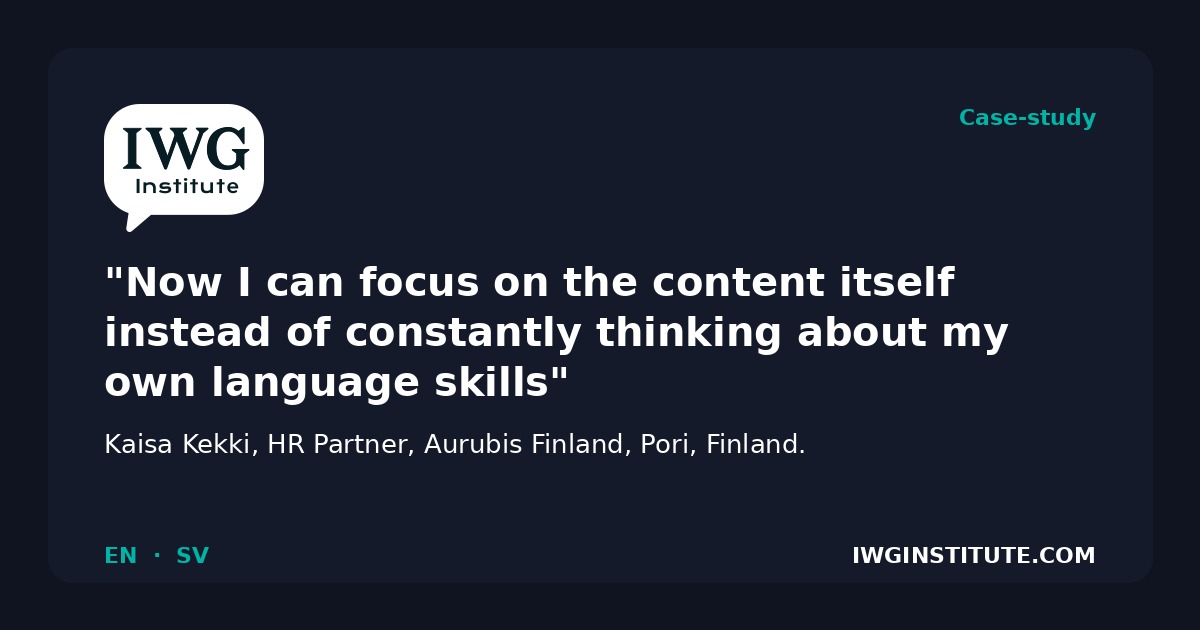
Today, English is part of HR system projects, where discussions, materials and meetings are in English, and of cooperation with Group HR colleagues. Situations like these would once have felt challenging because of the lack of professional vocabulary. Now Kaisa can move things forward in English naturally. She also gives presentations in English: “Now I can focus on the content itself instead of constantly thinking about my own language skills.”
Asked whether English has affected her career, Kaisa is direct: “Yes. Developing my English has made the move to my current role easier and has made it possible to take part in international projects and Group-level cooperation.” Without the courses, she says, she would probably still be less confident, and international meetings, system projects and English presentations would need more preparation, and she might not involve herself in discussions as actively.
Where the learning happens
Kaisa is honest about what a course can and cannot do. She estimates that about 40% of her progress came from the courses and 60% from daily work. “The courses gave a strong foundation, the HR vocabulary I needed and the courage to use the language, but the biggest development has come from actively using English in different work situations.”
Neither Henna nor Kaisa credits the courses alone for where they are now. But in both cases, the right language opened a concrete door: for Henna, a move into sales with the customers she already speaks to in their own language; for Kaisa, a seat in the international work she once would have found challenging.
About IWG Institute
Find out how IWG Institute works with different industries: iwginstitute.com
Maria Kunz, Director of Studies · maria.kunz@iwginstituutti.fi · +358 40 5877 142
Sources
- Aurubis Finland, about us, aurubis.com.
- Quotes are from interviews with Henna Rantala and Kaisa Kekki, translated from Finnish.